Women's Wellness Report - Posture & Spine · 50% OFF TODAY ONLY while stock lasts
Top Physical Therapists: "This Is The Fastest Way To Stop A Neck Hump Getting Worse - And It Happens While You Sleep"
I have treated the neck hump for 19 years. I gave my own mother the same exercise sheet I gave everyone else. The thing that finally changed her neck was not in my clinic. It was on her bed.
By Written by Dr. Karen H., DPT - Doctor of Physical Therapy, as told to the Numa Sleep Desk
Updated September 2026 · 9:15 am EST

Dear Friend With A Neck Hump,
If you've noticed a bump forming at the base of your neck...
If you dread being photographed from the side, and you've started checking which pictures go on Facebook...
If you catch your reflection in a car window or a shop mirror and feel a jolt at the 'old woman' looking back at you...
If you've already done the posture correctors, the chiropractor appointments, the YouTube exercises, the braces, and you're still exactly where you started, or worse...
Then what I'm about to share may change everything.
But I need to warn you.
What you're about to read will make you angry.
Because the thing that was feeding your neck hump has been sitting under your head, every night, for years. Nobody in a white coat ever asked about it. I never asked about it. And I'm the one who's supposed to know.
My name is Dr. Karen H.
I'm a Doctor of Physical Therapy. I've spent 19 years in clinical practice, most of it in cervical and postural rehabilitation. I've assessed more forward-head postures than I could count, and I've handed out more chin-tuck exercise sheets than any human should.
And until about two years ago, I believed everything I had been trained to believe about the dowager's hump.
The Night Everything Changed...
My mother's name is Anne.
She's 71. She taught fourth grade for 33 years: three decades of leaning over small desks, bending to a child's height, marking papers at a kitchen table that was always slightly too low.
She is the most dignified woman I know.
Or she used to be.
Two summers ago my daughter was in the end-of-year school play. Mom drove two hours to be there. I'd saved her a seat in the front row.
She took one look at the stage, said the view was better from the back, and sat in the last row on her own.
I knew the truth.
She couldn't tilt her head back far enough to see the stage from the front. The hump at the base of her neck had pulled her head so far forward that looking up hurt.
My mother, who had taught 33 years, raised three children, and never once asked for help with anything, watched her granddaughter's play from the back of the hall so nobody would see her struggle.
And she was too proud to say so.
That night I sat in my car in her driveway for twenty minutes before driving home. Because I was a Doctor of Physical Therapy. I had spent 19 years treating this exact condition.
And I had never fixed it. Not really. Not for her. Not for any of the women who walked into my clinic with the same hump, the same frustration, the same slow resignation that this was simply what aging looked like.
But here's what destroyed me:
By the time I really paid attention, Mom had been quietly adjusting her life around the hump for years.
She wore scarves to every occasion, no matter the weather. She positioned herself at the end of rows in church so she could turn slightly and nobody would see her profile. She stopped going to her friend's photography group. 'Not interested anymore,' she said.
When I finally sat with her and asked directly, she said: 'I just don't want people to look at me and see an old lady, Karen. I'm not ready for that.'
She was 69 and she felt like she was disappearing.
And I had given her a sheet of exercises and told her to 'work on her posture.'

The 'Experts' Weren't Any Better
I had referred Mom to colleagues I trusted. Let me tell you what that got her:
❌ The chiropractor - twice-monthly adjustments at $95 a session. Her posture would improve for a day or two after each visit. Then, slowly, the head would drift forward again, and we'd be back at square one. $2,280 a year. Indefinitely. 'Maintenance care,' he called it. I call it a hamster wheel.
❌ The physical therapist I sent her to - chin tucks, shoulder blade squeezes, doorway stretches. She did them faithfully for four months. Twenty minutes a day. The hump didn't move.
❌ The posture brace from Amazon - she wore it two hours a day. Perfect posture while it was on. The moment she took it off, her head dropped forward within minutes, because the brace was doing the work her muscles should have been doing.
❌ Her primary care doctor - 'It's part of aging, Anne. Try to stand up straight.' Eleven words. That was his entire contribution.
That last one is the one that keeps me up at night.
'It's part of aging.'
Said to a 69-year-old woman who was hiding from her granddaughter's school play.
I went to war with everything I thought I knew about this condition.
The Discovery That Was In Her Bedroom The Whole Time
It started with something small.
I stayed over at Mom's one night that autumn. At 6am I found her asleep in the recliner in the living room, half sitting up, a cushion wedged behind her head, the way she'd slept 'for years' apparently. She told me flat pillows made her neck hurt, so she'd stopped using the bed.
I stood there with my coffee and had a thought I couldn't shake.
Every single thing we do for the neck hump happens in the daytime. The adjustments. The exercises. The brace. The 'sit up straight'. Twenty minutes here, an hour there.
And then the patient goes home and spends eight hours with her head in whatever position her pillow puts it in.
I'd never once asked a hump patient what she was sleeping on.
For the next five months I became obsessed. I pulled every study I could find on hyperkyphosis (the medical term for dowager's hump) and on sleeping posture. I went to a cervical rehabilitation workshop in Denver that I'd skipped for years because I thought I already knew enough. I spent more on continuing-education courses and research access than I'd like to admit to my husband.
And what I found made me want to put my fist through my office wall.
Because the answer had been there all along. It was in the sleep-posture literature. Osteopaths and manual therapists had been talking about night-time head position for decades.
It was almost completely ignored by the mainstream posture model that most physical therapists, including me, had been following for their entire careers.
Here's what nobody tells you:
The entire neck hump industry is built on treating a third of the problem.
We fix the posture you hold for the hours you're awake, and we ignore the posture you hold for the hours you're asleep. And the sleeping posture is the one you can't correct with willpower, because you're not conscious for it.
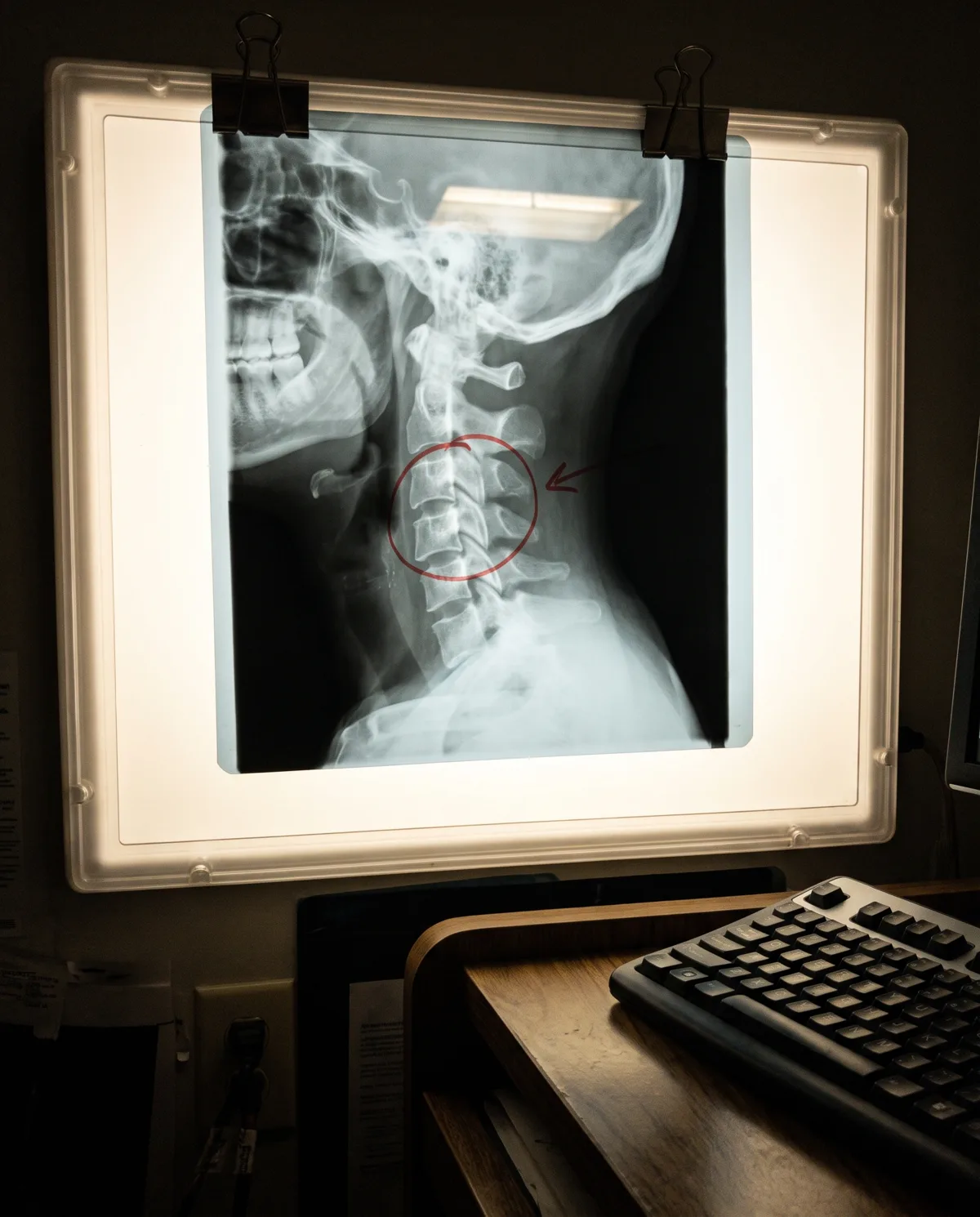
The Real Root Cause Of Your Neck Hump
Think of your head as a bowling ball balanced on a broomstick.
When everything is working, your head sits directly over your spine: balanced, almost weightless to the muscles supporting it.
For every inch your head sits forward of that line, the effective load on your neck roughly doubles. Two inches forward, which is common for a woman with a visible hump, and your neck is carrying something like 20 extra pounds.
Your body is intelligent. It doesn't let that happen without responding. It builds a protective cushion of tissue at the base of the neck, at the C7 vertebra, right where the neck meets the upper back, to stabilise the area under the load.
That cushion is your hump.
It is not a disease. It is not a deformity. It is your body defending itself against a head that has been held forward for too long.
Now here is the part I missed for 19 years.
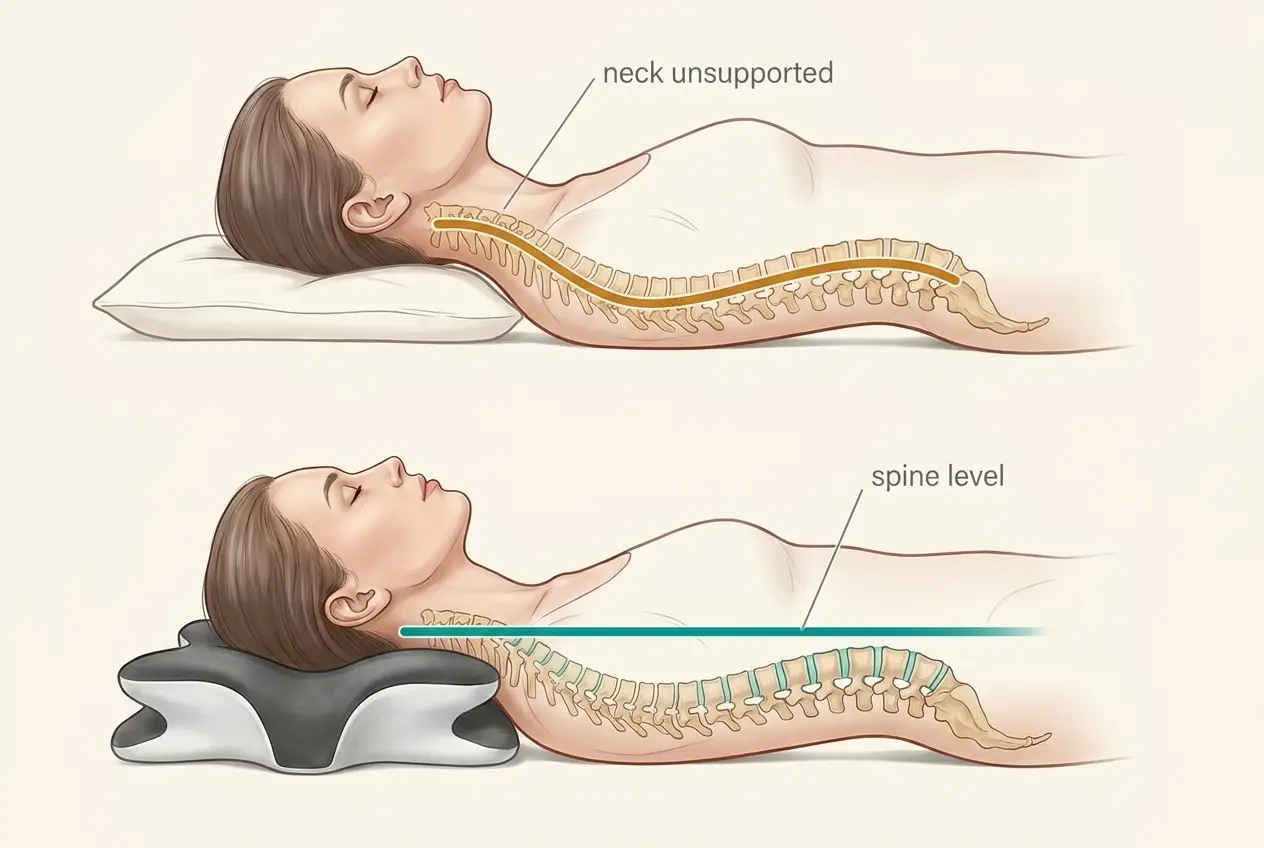
When you lie on your back on an ordinary pillow, or on two stacked pillows, the pillow pushes your chin toward your chest. That is forward head posture, lying down.
When you lie on your side on a flat pillow, there is a gap between your shoulder and your ear. Your head tips down into it and your neck bends. That is the same forward drift, sideways.
Either way, your neck spends eight hours a night rehearsing the exact position that builds the hump. The small muscles at the base of your skull, the ones that are supposed to hold your head over your spine, spend the whole night either jammed short or stretched long. They never get to rest at their proper length.
Then you get up, and I spend twenty minutes trying to undo it.
You can't win that. Nobody can. Twenty minutes against eight hours, every day, for years.
You cannot stretch your way out of a bad night posture.
Why Nobody Told You
The sleep-posture research has been available for a long time.
But here's the thing.
You can't bill for something that works while the patient is asleep. There is no appointment in it. No follow-up. No 'let's recheck in six months.'
There's no money in fixing the night. There's enormous money in 'maintenance care', in keeping women returning, twice a month, forever.
Your chiropractor knows how to give your neck temporary relief. He may genuinely want to help you. But the model he operates in, the model I operated in for nearly two decades, is built around your return visits, not your recovery.
Think about it:
You wouldn't fix a door that keeps swinging open by pushing it shut every twenty minutes.
You'd fix the hinge.
But that's exactly what the posture industry does: pushes your shoulders back, tucks your chin in, tells you to hold it there. And the moment you go to sleep, everything collapses forward again.
The 8-Hour Fix Hiding In Plain Sight
Three weeks after the Denver workshop I drove to my mother's house.
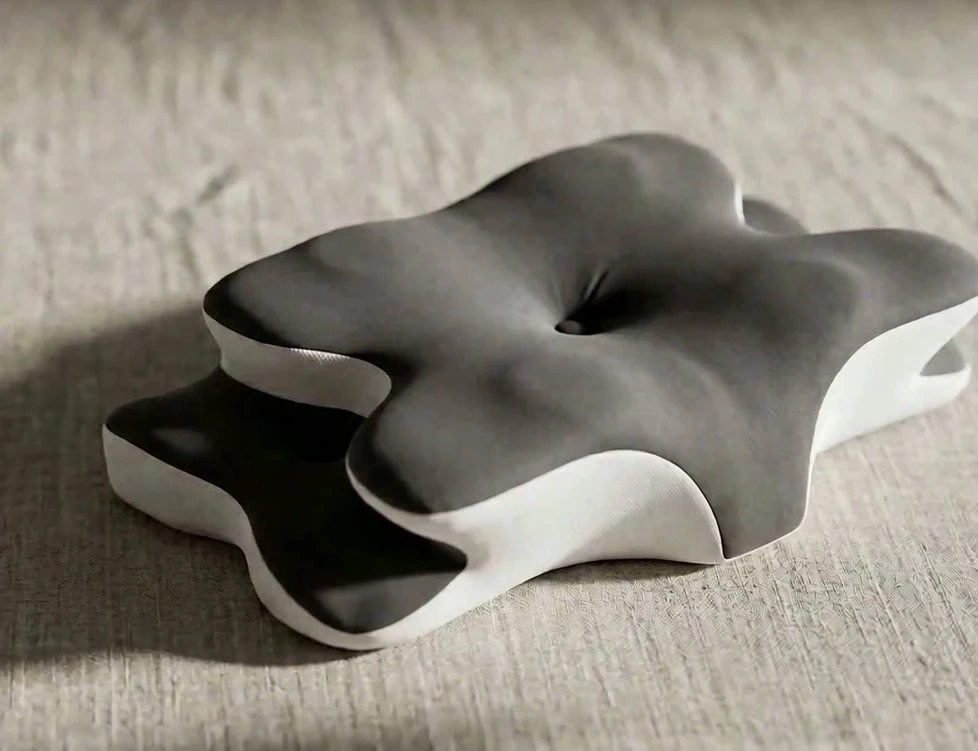
I had a pillow in the back seat. Not a special clinical one. A contoured pillow shaped like a butterfly, which a colleague at the workshop had told me half her older patients had quietly switched to.
I showed Mom how to lie on it: head in the centre cradle, the raised edge under the curve of her neck, shoulders slotted under the wings. Then I told her to go back to her own bed for one night and just... sleep.
She called me the next morning.
'Something happened last night,' she said. 'I don't know what you did, but when I woke up my neck felt different. Like something had let go.'
By the third week my daughter asked her if she'd changed her hair.
'You look different, Grandma. You look taller.'
At Thanksgiving, four months later, my mother stood at the head of the table and let my brother take a family photo. She didn't stand behind anyone. She didn't angle her body away from the camera. She stood straight and looked directly at the lens.
She hadn't done that in six years.
I'm a physical therapist with 19 years of training and a wall of continuing-education certificates.
It took a pillow to do what none of it had done for my own mother.

This Is Not What The Posture Industry Wants You To Hear
After Mom's results, word spread the way it does in a family.
Her neighbour Barbara, 68, a former bookkeeper who had worn a posture brace to her granddaughter's wedding because she was ashamed of how her back looked in photos, came to my mother's door asking about 'that thing Karen had you do.'
Two weeks later Barbara sent me a text. 'I caught myself in the mirror this morning and I stood there for five minutes. I haven't looked at myself sideways without bracing for it in three years.'
Then Mom mentioned it at her church group. Six women wanted to know more.
I started asking every hump patient in my clinic the question I should have been asking for 19 years: 'What is your neck doing for the eight hours you're not in this room?'
The answers were all the same. Two soft pillows. One flat one. A recliner. A rolled towel. Nobody had ever been told it mattered.
That's when the pushback started.
A senior colleague I'd known for fifteen years pulled me aside at a regional conference. 'Karen, you're oversimplifying. People need comprehensive treatment plans.'
'Oversimplifying.' That's what he called it.
What he meant was: you're making the solution too simple. Too cheap. Too easy to do at home without us.
I still prescribe exercises. I still tell patients to take screen breaks. None of that has changed.
What's changed is that I no longer pretend twenty minutes of daytime work can beat eight hours of night-time damage.
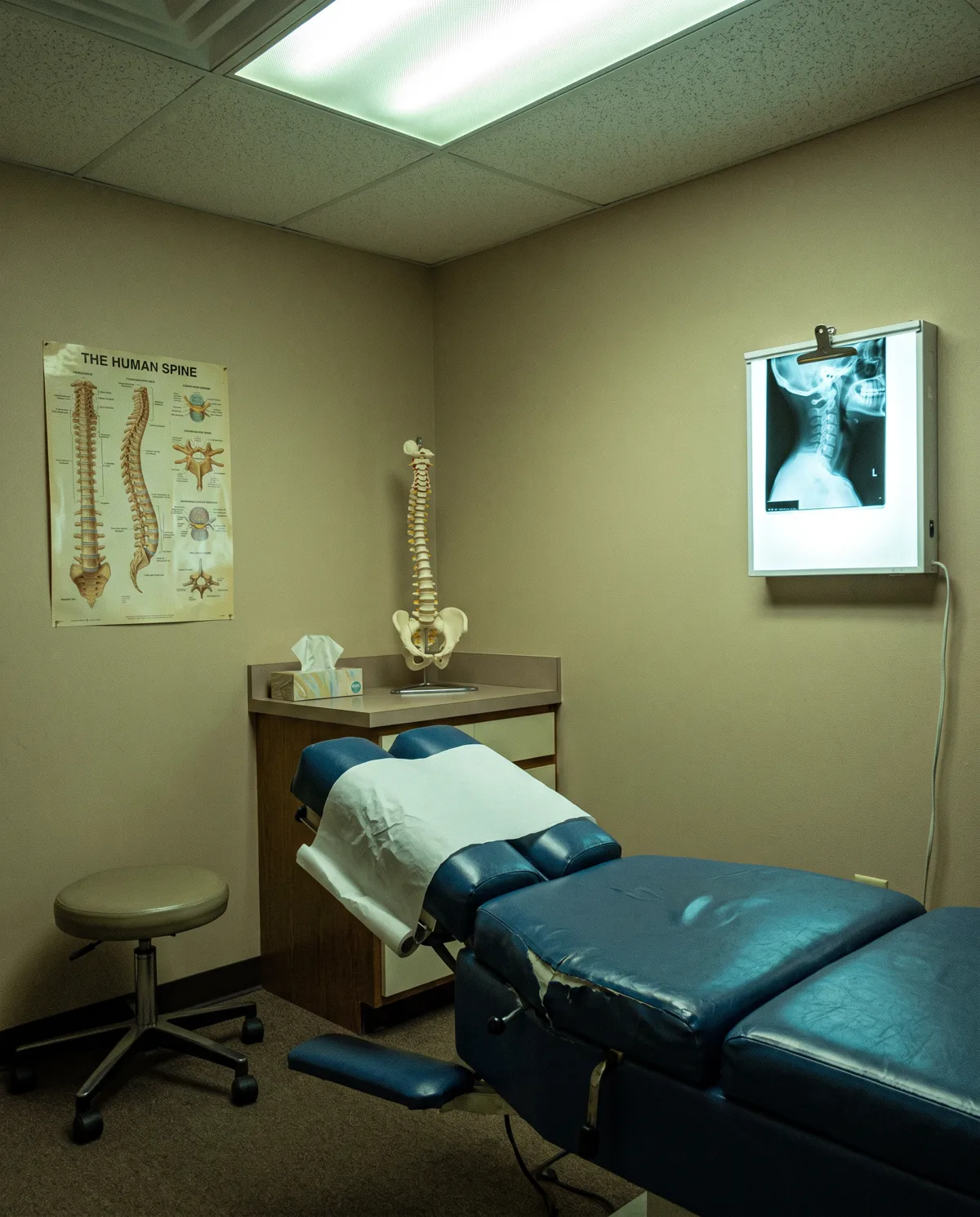
Introducing The Pillow That Fixes The Other 8 Hours
It's called the Numa Pillow.
It is a chiropractor-approved contoured pillow built on one principle: hold the head level over the spine for the whole night, on your back and on your side, so the muscles that build the hump finally get eight hours at their proper length.
Here's what it does:
✅ The centre cradle stops your head rolling - the slow overnight drift that pulls your neck forward is the drift that feeds the hump. The cradle holds the head still, over the spine, all night.
✅ The raised neck edge supports the curve - instead of letting your chin push toward your chest, it fills the space under your neck so the head sits back where it belongs.
✅ Two heights, one pillow - flip it: the higher contour (about 11cm) bridges the shoulder gap for side sleeping, the lower one (about 9cm) keeps back sleepers level. This is the part no flat pillow can do.
✅ The wings give your shoulders and arms somewhere to go - so you stop fidgeting for a position at 2am and breaking your own alignment.
✅ Slow-rebound memory foam - holds the geometry for the whole night instead of flattening by 3am.
Here's Exactly What Happens Over One Night
The first ten minutes: the settle.
First impression, from Mom and from every patient since: firmer than it looks. The foam pushes back slowly instead of swallowing your head. Your neck settles into the raised edge and, for most women, that's the moment they feel the base of the skull unclench for the first time in years.
Hours one to three: the muscles switch off.
This is what a flat pillow never gives you. With the head held over the spine, the small muscles at the base of the skull have nothing to hold up. They stop working. Women who have slept with their neck 'on duty' for a decade describe this as a warmth, or a heaviness, spreading from the base of the skull.
Hours three to eight: the reset.
It's not enough to rest the muscles once. They need to learn, through night after night of the same input, that they are safe to stay at their natural length. This is what the exercises can't do in twenty minutes, because they strengthen and stretch, but they don't give the body eight uninterrupted hours in the corrected position.
The pillow does.
The morning after?
You do your careful little test-turn out of habit, and nothing catches. Over the following weeks of the same nights, women describe feeling taller, standing differently, and, in my mother's words, 'not having to think about my neck any more.'
The Results That Have Colleagues Calling Me
When I got past my own mother's results, I did what I tell patients to do with any product: read the public reviews. All of them, not the highlights.
There are more than 3,800 verified reviews, averaging 4.7 stars. Ninety-three percent of sleepers report waking with less neck pain. The ones that sounded most like the women in my clinic:
From verified Numa reviews:
I had been going to the chiropractor twice a month for two years. Every time I left I felt better. By Thursday I was back where I started. My daughter sent me this. After three weeks my chiropractor asked me what I had been doing differently. I told him I hadn't needed to come back.
Carol K., Verified buyer, Phoenix AZ
Retired hairdresser. Twenty-six years of leaning over clients. I developed the hump in my mid 50s. I bought this because my granddaughter asked me why my neck looked like that. Three months in, I stand straighter and my collars fit again.
Linda M., Verified buyer, Tampa FL
My doctor told me to accept it as part of aging. I'm 67 and I refused. This is the first thing in four years of trying that made a visible difference. I sleep on my back on it and wake up with my head where it should be.
Margaret T., Verified buyer, Charlotte NC
Headaches every single morning for months. Doctor said neck tension, look at how you sleep. Two weeks on this and the morning headaches have mostly stopped.
Tasha J., Verified buyer
The Price That's Causing Professionals To Panic
Let me show you what living with a neck hump actually costs:
👉 Chiropractor, twice monthly, one year: $2,280. Stops working when the appointments stop.
👉 Physical therapy, twice a week for three months: $4,800. Exercises that never touch the eight hours.
👉 Posture brace, replaced as it wears: $40 to $80 each. Only works while you're wearing it.
👉 Clinic-grade cervical pillows at medical suppliers: $200 and up. I know, because I used to stock them.
👉 The Numa Pillow, once: $59.99 today. Works every night, for years.
The industry loves the first three options.
Know why?
Because you keep coming back.
Temporary relief equals a lifetime customer. It's a business model built on your hump getting worse, not better.
The 50% Off 'Skip The Appointment' Offer
Numa doesn't sell through clinics or medical suppliers, and it isn't on Amazon. That's deliberate. No distributor markup, no clinic markup, and none of the copies that flood the marketplaces with the same shape and a block of cheap foam inside.
So instead of pricing it like a clinic product, they're doing the opposite.
Today it's 50% off. $59.99, down from $119.98.
Less than one chiropractor visit.
Less than a dinner out.
For the only thing I've found that addresses the eight hours nobody else is treating.
Why would they do this?
Because every woman who sleeps on it and stands straighter is a message to an industry that told her to 'just accept aging.' They would rather five thousand women try it this month than five hundred.
The 30-Night 'Stand Differently' Guarantee
Look. I get it.
You've been burned before. Braces that gather dust. Appointments that wore off by the weekend. Devices that arrived, got used twice, and went in the closet.
So here's the promise:
Sleep on the Numa Pillow for 30 nights. Every night. Head in the cradle, neck on the raised edge.
Feel the base of your skull let go. Feel your head sit differently in the morning. Catch yourself in the mirror one day and feel something shift.
And if you don't, send it back for a full refund. No forms. No restocking fee. No questions asked.
Worst case, you get your money back. Best case, you stop hiding from the side of the camera.
But Here's The Catch (And It's A Big One)
This 50% discount is today's price, not next week's. When today's allocation is gone, the price goes back to $119.98. Still worth every penny. But not $59.99.
And this is important: you won't find the real Numa on Amazon. You'll find the copies. Same butterfly shape in the photos, one slab of soft foam inside, flat by the second week. They copy the shape. They can't copy what's inside. The only place to get the real thing is the official site.
If you're reading this, today's price is still live. I can't promise it will be tomorrow.
And here's what I want you to understand:
Every night you wait is another eight hours with your head forward.
Another night the hump sets a little deeper.
Another day you adjust your life, the scarves, the back row, the photos you step out of, around something that does not have to keep getting worse.
The Choice That Will Define Your Next Decade
Right now, you are at a crossroads.
Path #1: Keep doing what you're doing.
Keep going to the chiropractor and feeling better for two days. Keep doing exercises that address the daytime and not the night. Keep watching the hump in the mirror, year after year, getting a little worse. Keep adjusting your life around it: the clothes you choose, the photos you avoid, the mirror you don't look at.
Keep being a repeat customer for an industry that profits from you not getting better.
Path #2: Fix the eight hours.
Spend less than you'd pay for one chiropractor visit. Sleep on the pillow that more than 3,800 people have rated 4.7 stars. Give the muscles that build the hump eight hours a night at their proper length, instead of twenty minutes. Wake up one morning, catch your reflection, and feel something you haven't felt in years: hope.
The choice seems pretty obvious to me.
Here's Exactly What To Do Next
1. Click the button below.
2. Choose your pack. (Pro tip: get two. One for a sister or a friend who has been hiding her neck for as long as you have. Two-packs save more.)
3. Fill in your shipping details.
4. Wait for it to arrive.
5. Sleep on it the first night it arrives. Head in the cradle, neck on the raised edge. Let the night do the work.
6. Do your test-turn the next morning, and notice what doesn't happen.
But whatever you do, don't close this page thinking 'I'll order later.'
Later is another night with your head forward.
Later is another family photo you angle away from.
Later is the distance between the woman you are and the woman who stood at the head of the Thanksgiving table.
Get 50% Off The Numa Pillow Today
$59.99 today, down from $119.98, with a 30-night sleep trial. Sleep on it for a month, and if your mornings haven't changed, send it back for a full refund.
P.S. I just got off the phone with my mother. She's signed up to volunteer as a reading tutor at the elementary school next semester. She said, and I'm quoting, 'I'm not hiding at the back of any more rooms.' That's what this is about.
P.P.S. The Numa Pillow is chiropractor approved, comes in two heights for back and side sleepers, and is backed by a 30-night sleep trial. If it doesn't change your mornings, it costs you nothing.
Advertisement. This page is sponsored by Numa. The author's account is a composite drawn from clinical experience and verified Numa customer reports; names and identifying details have been changed. The information on this page is not medical advice and is not a substitute for professional diagnosis or treatment. The Numa Pillow is not intended to diagnose, treat, cure or prevent any disease. Individual results vary.